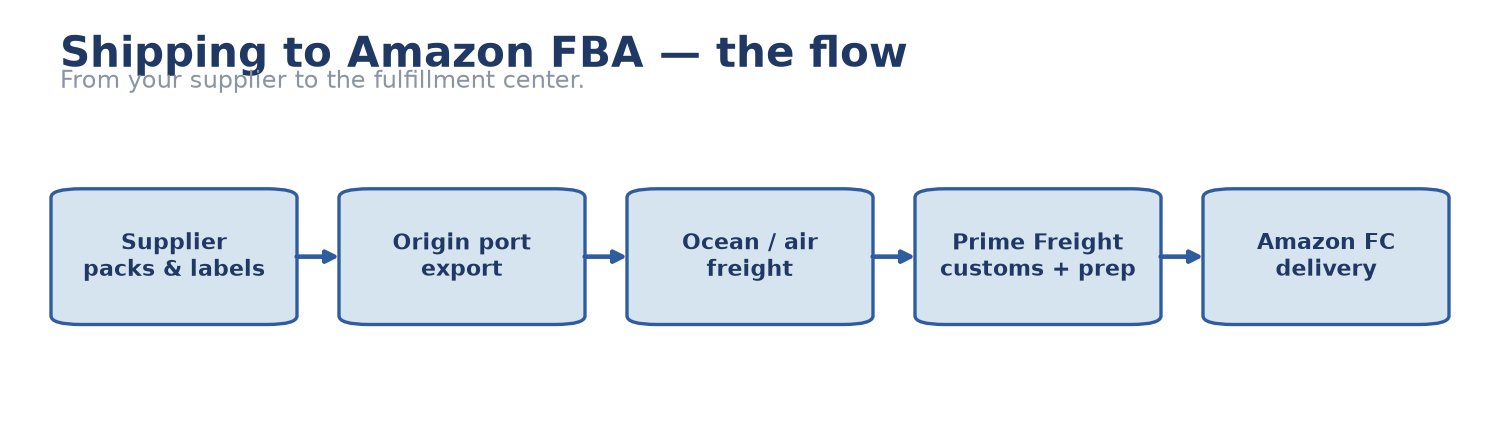
Shipping to Amazon FBA, end to end
Short answer
Shipping to Amazon Fulfillment by Amazon (FBA) works like any other import — supplier pickup, ocean or air freight, and customs clearance — with one difference: Amazon will only receive cargo that meets its labeling, palletizing, and delivery-appointment rules. We handle the freight and, with limited access to your Amazon Seller Central account, prepare your cargo so the fulfillment center accepts it on the first try.
The end-to-end journey
Here is what happens to an Amazon FBA shipment from origin to the fulfillment center.
Create your shipping plan in Seller Central. Amazon assigns each shipment one or more FBA shipment IDs and tells you which fulfillment center(s) your units are going to. This step drives everything downstream, so create it before your cargo ships.
Book the freight. Request a booking with us and share your FBA shipment IDs, the destination fulfillment center(s), and your chosen final-mile method. See Multiple FBA locations in one shipment if Amazon split your plan across several centers.
Origin handling and labeling. Your supplier labels the products and cartons (see Amazon labeling and FNSKU requirements). Getting this right at origin is the single biggest way to avoid delays and extra fees.
Ocean or air freight to the destination port. Choose your mode based on cost, speed, and volume — see FCL vs LCL vs parcel and Types of air service.
Customs clearance. Your cargo is entered and cleared. Amazon will not act as Importer of Record and will not accept any shipment on which duties or taxes are still owed — clearance must be complete and prepaid before delivery.
Our destination warehouse. Your cargo arrives at our warehouse, where we can palletize, apply Amazon carton and pallet labels, transload, or hold it in storage (see Amazon storage options).
Book the delivery appointment. Fulfillment centers receive by appointment only, in tight windows (sometimes overnight). We book the appointment once your cargo is physically in our warehouse.
Final-mile delivery. Your cargo is delivered by the method you chose — an Amazon-partnered carrier, or our own trucking. See Estimating Amazon final-mile charges and Paying Amazon for final delivery.
What Amazon requires before it will receive your cargo
Amazon holds imported inventory to the same standard as domestically sourced inventory. In practice that means:
Amazon is not the Importer of Record. When cargo is consigned "in care of FBA," Amazon will not act as the shipper or importer of record. Name yourself (or an agent) as consignee and Importer of Record, not Amazon.
No duties or fees owed on arrival. Deliveries with unpaid duties, taxes, or other charges are refused. Clearance must be prepaid.
Correct labeling. Every product and every carton must carry the right Amazon labels in the right place. See Amazon labeling and FNSKU requirements.
Correct palletizing. Pallets must meet Amazon's specifications. See Amazon palletization rules.
A booked delivery appointment. No appointment, no delivery.
A shipment that misses any of these is turned away, which costs time and money to fix.
Air, LCL, or FCL to the fulfillment center
Transit time from the destination port to the fulfillment center depends on your mode and your final-mile choice:
Air is fastest to the port; final-mile is usually small-parcel or LTL.
LCL (Less than Container Load) is deconsolidated at our warehouse, then palletized and delivered.
FCL (Full Container Load) can be delivered floor-loaded or palletized; floor-loaded containers take longer to unload and are harder to schedule.
Your operations team will confirm the realistic timeline for your specific lane and method when you book.
How this works at Prime Freight
With limited access to your Seller Central account, we enter shipment details (such as pallet size), download and print your FBA and pallet labels, and apply them at our warehouse after palletizing — so your cargo meets Amazon's rules without you handling the paperwork. We only ask for the access we need; see Why we need Seller Central access.
Because appointments and final-mile capacity get tight before major sales events, plan ahead during peak periods — see Planning around Prime Day and holidays.